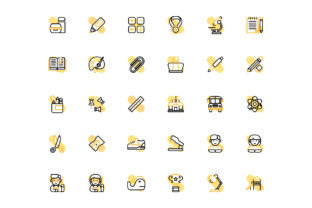
Back to School - Calculator: Vector Graphics for Creative and Professional Projects
Vector designs have become an essential resource for creators, educators, and business owners who need flexible, high-quality visuals that can adapt to various mediums. When focusing on the Back to School - Calculator theme, vector art offers unique advantages for printable projects, digital presentations, and marketing materials. These files, typically provided in EPS10 format with a JPEG preview at 300 DPI, allow users to resize, recolor, and customize elements without losing clarity. Understanding how to leverage these assets can transform a simple design into a versatile tool for classrooms, promotional campaigns, or personal crafting.
The Value of Vector Format in Educational Design
Vector graphics, unlike raster images, are built from mathematical paths rather than pixels. This fundamental difference means that an EPS10 file—such as those included in a Back to School - Calculator pack—can be scaled to any size without degradation. For educators preparing large posters or small worksheet icons, this scalability ensures consistent quality. A 300 DPI JPEG preview provides a quick reference at high resolution, but the real power lies in the editable vector source. Designers can alter colors, adjust shapes, or combine elements to create custom visuals that match specific curriculum needs or branding guidelines.
Printable projects benefit directly from this flexibility. A Back to School - Calculator vector might appear on a math poster, a homework planner, or a classroom decoration set. Because the file is fully resizable, the same design can be used for a binder cover, a sticker, or a banner without requiring separate artwork. This efficiency saves time and reduces resource waste, making it a favorite among school administrators and freelance designers alike.
Real-World Applications for Educators
Teachers often need materials that engage students while remaining affordable to produce. Vector designs allow them to print handouts with crisp calculator illustrations, create bulletin board elements, or design activity sheets that reinforce mathematical concepts. For instance, a vector set might include multiple calculator styles—scientific, basic, or graphing—that can be integrated into lesson plans about arithmetic, algebra, or data analysis. The ability to recolor these vectors to match school colors or seasonal themes adds a layer of customization that static images cannot provide.
- Use vector calculators on worksheets to illustrate functions or operations.
- Create large-format posters for classroom displays that remain clear from a distance.
- Design flashcards or game pieces that are durable after printing and laminating.
- Incorporate calculator vectors into digital resources like interactive PDFs or slide decks.
Beyond direct instruction, these vectors support organizational tools. A teacher might design a homework tracker with a calculator icon to denote math assignments, or craft a progress chart that uses calculator motifs to track student achievement. The versatility of vector files means that a single purchase can yield dozens of variations, each tailored to a specific educational context.
Commercial Opportunities for Small Business Owners
Entrepreneurs in the educational supply sector, as well as those in graphic design and print-on-demand services, find vector packs like Back to School - Calculator invaluable. The 100% fully resizable nature of EPS10 files allows business owners to adapt a single design across multiple products: T-shirts, mugs, notebooks, tote bags, and greeting cards. Since the vectors are editable, they can also be combined with other elements—such as pencils, books, or apples—to create unique compositions that resonate with back-to-school shoppers.
A primary advantage of using vector over raster is the reduction in production errors. When submitting artwork to printers, raster images may require precise resolution specifications to avoid pixelation, especially on large items like banners or wall decals. Vector files, on the other hand, hold perfect sharpness at any size. Business owners can focus on the creative aspect, knowing that the technical quality is built into the file format. The included JPEG preview at 300 DPI offers a reliable representation of final output, useful for mockups or online listings.
Customization for Branding and Marketing
Many businesses need to maintain consistent visual identity across campaigns. With a Back to School - Calculator vector, a company can adjust the color palette to match its logo or seasonal promotions. For example, a tutoring center might use calculator vectors in their flyers, website headers, and social media graphics. By keeping the vector master file, they can quickly generate variations for different platforms without re-purchasing assets. This efficiency reduces costs and speeds up production timelines.
Print-on-demand entrepreneurs often operate with tight margins, so file versatility is critical. A vector design that works as a small icon on a phone case and as a large graphic on a hoodie ensures that inventory decisions are simpler. The fully resizable nature means no separate files are needed for different product sizes. This simplicity streamlines workflow and minimizes the risk of ordering incorrect artwork.
Technical Merits of EPS10 and High-Resolution Previews
The technical specifications provided in a typical Back to School - Calculator pack—EPS10 vector files and a 300 DPI JPEG preview—are deliberate choices that serve both novice and experienced users. EPS10 is a widely supported format that retains vector data through most professional design software, including Adobe Illustrator, CorelDRAW, and Affinity Designer. It also opens in some free open-source applications like Inkscape, making it accessible to budget-conscious creators. The JPEG preview at 300 DPI is a print-ready reference that shows exact colors and pixel-level detail, useful for clients or collaborators who cannot view EPS files directly.
One often overlooked characteristic is the layering within EPS vectors. Many professional packs organize elements into separate layers, allowing users to hide, edit, or delete components without affecting others. This structure is especially helpful when adapting a calculator design for different contexts. For instance, a scientific calculator vector might have distinct layers for the display, buttons, and casing, enabling a designer to swap the display text or change button colors independently. Such granular control is nearly impossible with raster images.
Considerations for High-Quality Printable Projects
When embarking on printable projects with Back to School - Calculator vectors, several factors influence the final result. First, always verify that the software you use supports EPS10 import. Most modern programs do, but some online-only editors may not. Second, while the preview file is useful for proofing, always work from the vector source for any output that will be printed or published digitally. Third, consider the paper or material quality. Vectors retain sharp detail even on textured surfaces, but the color profile (CMYK vs. RGB) should match your intended output device. Many EPS files are created in CMYK for print, but check the documentation if you need to convert to RGB for screen use.
- Open the EPS file in a vector editing application.
- Review the layer structure to understand how elements are grouped.
- Customize colors, sizes, or parts as needed for your project.
- Export in the appropriate format—PDF for print, PNG for web, or SVG for further digital editing.
- Test print a sample on plain paper before committing to expensive materials.
Another consideration is the file size. EPS10 vectors are typically compact because they store only mathematical coordinates. However, complex designs with many curves or gradients can be larger. The JPEG preview at 300 DPI may be several megabytes, but it serves as a quick visual reference. For workflow efficiency, keep the original EPS as your master file and only generate raster output when necessary.
Trends and Future Uses of Calculator Vector Art
The demand for back-to-school resources continues to grow, especially with the rise of hybrid learning environments where both digital and printed materials are used. Calculator vectors, in particular, align with the increasing emphasis on STEM education. Schools and educational content creators need visuals that are accurate, clear, and adaptable. Vector designs meet these requirements better than clip art or photographs, which often suffer from limited editability or resolution constraints.
Emerging technologies like augmented reality (AR) and interactive PDFs also benefit from vector assets. Because vectors can be embedded into digital files without loss, they can be scaled dynamically in AR applications or exported as SVG for web use. A Back to School - Calculator vector might be used as a marker for an AR math game or as an interactive button in an online textbook. The ability to customize colors and shapes makes these vectors suitable for diverse educational tools that appeal to different age groups and learning styles.
Combining Vectors with Other Design Elements
One sophisticated technique is to combine calculator vectors with other back-to-school motifs to create cohesive visual systems. For example, a vector set might include a calculator alongside a ruler, a compass, and a pencil. By using the same line style or color scheme, designers can build a library of icons that communicate mathematical themes without being repetitive. This approach is common in school yearbooks, event invitations, and promotional calendars. The EPS10 format allows for easy grouping and layering, enabling seamless integration of multiple elements.
For hobbyists, such as scrapbookers or home crafters, the appeal lies in the flexibility to resize and recolor without starting from scratch. A parent making a homework station for their child might print large calculator labels for storage bins or small icons for a homework schedule. The high-resolution JPEG preview helps visualize the final product before cutting or gluing. Since the vector file is 100% resizable, they can adjust dimensions based on available space or specific project requirements.
Business owners, especially those in print shops or design services, can offer clients faster turnaround times when using vector packs. Instead of recreating a calculator illustration from scratch, they can modify an existing high-quality vector to match client preferences. This efficiency translates into lower costs for clients and higher profit margins for service providers. The included JPEG preview acts as a client-facing proof, reducing the back-and-forth typically associated with custom design work.
Ensuring Long-Term Usability of Vector Files
To maximize the lifespan of a Back to School - Calculator vector pack, users should adopt best practices for file organization and backup. Always store the original EPS files in a dedicated folder with clear naming conventions. If you edit a vector, save a copy of the original before making changes. This precaution allows you to revert to the unaltered design if needed. Additionally, keep the JPEG preview in the same directory so you can quickly identify files without opening them in a vector application.
Another recommendation is to convert EPS files to SVG if you plan to use them extensively on the web. SVG is more web-native and can be styled with CSS, making it ideal for responsive design. However, the EPS10 source remains the most robust format for print and offline projects. By maintaining the vector master, you preserve the ability to scale in either direction without quality loss. This principle holds whether you are printing a business card or a billboard-sized banner.
Finally, consider licensing terms. Many vector packs come with royalty-free licenses that allow both personal and commercial use, but restrictions vary. Always review the terms provided with your Back to School - Calculator files to ensure your intended projects are covered. Respecting these boundaries protects both you and the original artist, and it supports the continued creation of high-quality vector resources.
Practical Observations from Regular Use
Designers who frequently work with vector packs report that the most valuable feature is the editability of individual components. For instance, a calculator vector might include separate elements for buttons, screen, and body. By adjusting the hue of the buttons or the gradient of the casing, the same base design can be used for both a playful children’s worksheet and a professional financial report. This adaptability reduces the need to purchase multiple design sets and ensures consistency across projects.
Another observation is that vector files with a clean layer structure reduce learning curve for new users. Many Back to School - Calculator packs organize content logically, grouping similar elements together. This organization means that even someone with basic vector editing skills can quickly achieve professional results. The high-resolution JPEG preview further assists by showing what the final design should look like, making it easier to assess changes in real time.
For larger teams, such as school marketing departments or educational publishers, having standardized vector assets streamlines collaboration. Everyone can work from the same source files, ensuring that printed materials and digital content share a unified look. The ability to export for different purposes—from web banners to textbook inserts—without losing quality is a significant efficiency gain. As back-to-school seasons return each year, these vector designs become reusable assets that continue to deliver value.
Adapting Vector Designs for Different Print Methods
Not all printing methods handle vector files the same way. For offset printing, EPS files are often preferred because they embed color information and fonts. For digital printing, such as inkjet or laser, vectors can be converted to high-resolution raster during the print driver process. The key is to maintain the original vector file and only rasterize at the final output stage. This practice preserves the option for future edits and ensures maximum quality across different print technologies.
Screen printing, common for apparel, also benefits from vector files. Separation of colors is easier, and the clean lines of vector art produce sharp edges on fabric. A Back to School - Calculator vector designed for screen printing might use solid colors without gradients to suit the process. The 100% resizable nature allows printers to adjust the artwork for different garment sizes without distorting the design. Similarly, for embroidery, vectors can be converted into stitch files with accurate paths, though some manual adjustment may be needed depending on complexity.
In home crafting, such as vinyl cutting or heat transfer, vectors are the standard input for cutting machines. The EPS10 format can be opened in software like Silhouette Studio or Cricut Design Space, allowing users to cut the calculator design from adhesive vinyl or iron-on material. The ability to resize without quality loss is critical here, because a small sticker and a large wall decal require the same sharp outlines. The included JPEG preview helps confirm alignment and color expectations before cutting expensive materials.
From classroom worksheets to commercial merchandise, Back to School - Calculator vector designs offer a blend of flexibility, quality, and efficiency that few other file types can match. By understanding the technical strengths and practical applications of these assets, users across educational, creative, and business fields can unlock their full potential for both printed and digital projects. The careful balance between a high-resolution preview and a fully resizable vector source ensures that every application—whether a simple handout or an elaborate marketing campaign—benefits from professional-grade artwork without the usual production headaches.